
✍️ Authored by: Dr. Aykut Gürel — Specialist in Oral, Dental and Maxillofacial Surgery 10+ years of clinical experience in periodontal surgery (bone grafts, sinus lifts, gum grafts) and peri-implantitis management. Multidisciplinary approach with periodontists in complex cases. Last updated: 7 May 2026
What Is Periodontology? — 60-Second Answer
- Periodontology = the specialty that studies the gums, bone, and all the tissues holding teeth in place
- Periodontist = a dentist with 3–4 years of additional specialty training (PhD or board specialty in Türkiye)
- Gum disease = ~80 % of periodontology cases
- Early diagnosis = critical for preventing tooth loss (periodontitis is the #1 cause of adult tooth loss in Türkiye)
- Treatment range = from professional scaling to surgical bone and gum grafts
💡 Important: Periodontology is not only gum disease treatment; it also covers peri-implant tissue protection, gum aesthetics (gummy smile, pink aesthetics) and the systemic links between oral inflammation and diabetes / cardiovascular disease.
Periodontist vs General Dentist
| Topic | General Dentist | Periodontist |
|---|---|---|
| Education | 5-year dental school | 5 years + 3–4 years periodontology specialty |
| Scope | Basic gum treatment, scaling | Advanced surgery, grafts, bone regeneration |
| Conditions | Gingivitis, simple curettage | Periodontitis, peri-implantitis, mucogingival surgery |
| Surgical approach | Limited | Flap surgery, bone graft, gum graft, laser |
Routine gum care is performed by the general dentist; bone-loss + surgery cases are referred to a periodontist or oral surgeon.
Scope of Periodontology
1. Gum Diseases (Gingivitis & Periodontitis)
Gingivitis is the early-stage inflammation that affects only the gum surface. It is reversible — proper oral hygiene + a professional cleaning resolves it in 2–3 weeks.
If untreated, it progresses to periodontitis — inflammation that extends to bone, causing gradual bone loss and ultimately tooth mobility. Periodontitis is not fully reversible, but it can be controlled and stabilized.
| Stage | Bone Loss | Symptoms |
|---|---|---|
| Gingivitis | None | Bleeding gums, redness, swelling |
| Mild periodontitis | < 15 % | Pocket depths 4–5 mm, mild bleeding |
| Moderate periodontitis | 15–33 % | Pocket depths 5–7 mm, gum recession beginning |
| Severe periodontitis | > 33 % | Tooth mobility, deep pockets > 7 mm, abscesses |
2. Peri-Implantitis
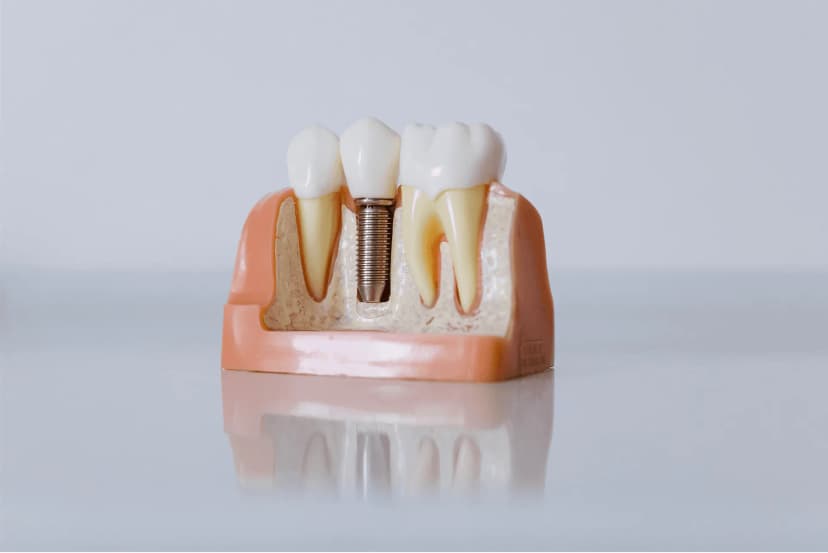
Inflammation around dental implants — analogous to periodontitis but on implants. It threatens implant longevity. Periodontology applies surgical decontamination + bone regeneration protocols.
3. Mucogingival Surgery
- Gum recession treatment — connective tissue grafts, FGG (free gingival graft), CTG (connective tissue graft)
- Crown lengthening — for "short tooth" appearance or pre-restorative purposes
- Frenectomy — releasing high muscle attachments
4. Bone Regeneration
- Bone grafts (autograft, allograft, xenograft)
- GBR (Guided Bone Regeneration) — membranes + bone substitutes
- Sinus lift — for posterior maxillary implant cases (detail)
5. Pink Aesthetics
- Treatment of gummy smile (excessive gum display)
- Smile-design support — gum contour symmetry
- Botulinum toxin for high-lip-line gummy smile (in collaboration with maxillofacial surgery)
Periodontology Treatment Steps
Stage 1: Diagnosis
- Clinical examination — pocket depth measurement at 6 sites per tooth
- Bleeding on probing index
- Mobility scoring
- Periodontal X-ray (panoramic + periapical)
- 3D dental tomography (CBCT) for advanced surgical cases (detail)
- Risk-factor screening: smoking, diabetes, family history
Stage 2: Initial Phase (Non-Surgical)
- Professional scaling (supragingival)
- Root planing / SRP (subgingival)
- Local anesthesia if needed
- Antibacterial irrigation (chlorhexidine)
- Patient training: proper brushing technique, interdental brushes, flossing
80 % of patients respond fully to this stage and need no surgery.
Stage 3: Re-Evaluation (4–6 weeks later)
- Pocket depths re-measured
- Bleeding rate re-checked
- Decision: maintenance program OR surgical phase
Stage 4: Surgical Phase (if needed)
- Flap surgery — open access to root surfaces
- Bone grafts — to fill defects with biocompatible material
- GBR — guided bone regeneration with membranes
- Connective tissue graft — for gum recession
- Laser-assisted treatment — selected cases
Stage 5: Maintenance (Long-Term)
- 3-month checkups (high-risk patients)
- 6-month checkups (low-risk patients)
- Lifelong follow-up
Periodontal Treatment Prices 2026 (Istanbul)
| Procedure | 2026 Price (EUR / USD) |
|---|---|
| Scaling (full mouth) | €60 – €120 / $65 – $130 |
| SRP — Root planing per quadrant | €100 – €180 / $110 – $200 |
| Gingivectomy (per region) | €110 – €220 / $120 – $240 |
| Gum graft (per tooth) | €280 – €560 / $310 – $610 |
| Bone graft (per region) | €330 – €670 / $360 – $730 |
| Sinus lift | €560 – €1,400 / $610 – $1,520 |
| Peri-implantitis surgery | €440 – €1,100 / $480 – $1,200 |
| Crown lengthening | €170 – €340 / $185 – $370 |
| Maintenance (3-month checkup) | €60 – €120 / $65 – $130 |
💡 Pricing factors: number of sites, graft material brand, regenerative membranes used, complexity, anesthesia type.
ℹ️ Insurance: SRP and routine cleaning may be partially covered by Turkish national insurance (SGK); surgical periodontology and grafts are typically self-pay. International private insurance varies — most aesthetic periodontal work is out of scope.
Periodontal Disease & Systemic Health
The mouth–body connection is well-documented in periodontology:
| Systemic Condition | Periodontal Link |
|---|---|
| Diabetes | Bidirectional — uncontrolled diabetes worsens periodontitis; periodontitis worsens glycemic control |
| Cardiovascular disease | Chronic gum inflammation correlates with atherosclerotic risk |
| Pregnancy | Gum inflammation increases preterm-birth risk |
| Rheumatoid arthritis | Inflammatory crossover (P. gingivalis bacteria) |
| Alzheimer's | Recent studies show oral bacteria in the brain |
Implication: Periodontology is not just dental care — it is an integral part of overall health.
When Should You See a Periodontist?
- Bleeding gums when brushing
- Visible gum recession (longer-looking teeth)
- Bad breath (halitosis)
- Pus from the gums
- Tooth mobility
- Family history of periodontitis
- Diagnosis of diabetes
- Existing implants — peri-implant maintenance
💡 Maintenance is critical: patients with treated periodontitis must continue 3- to 6-month follow-ups for life. Skipping this raises the recurrence rate from < 10 % to over 50 %.
Periodontology and Implant Treatment
Implant placement and periodontology overlap in three areas:
- Pre-implant evaluation: Periodontal stability is mandatory before implants. Active inflammation is treated first.
- Bone preservation: Bone grafts and sinus lifts prepare insufficient bone before implants.
- Peri-implant maintenance: After implant placement, regular periodontal cleaning prevents peri-implantitis (the leading cause of late implant failure).
Academic References
The medical content in this guide draws on the following independent academic sources:
-
Tonetti MS, Greenwell H, Kornman KS. Staging and grading of periodontitis: framework and proposal of a new classification. Journal of Periodontology, 2018. https://pubmed.ncbi.nlm.nih.gov/29926951/
-
Renvert S, Persson GR, Pirih FQ, Camargo PM. Peri-implant health, peri-implant mucositis and peri-implantitis: case definitions and diagnostic considerations. Journal of Clinical Periodontology, 2018. https://pubmed.ncbi.nlm.nih.gov/29926496/
-
Sanz M, Marco Del Castillo A, Jepsen S, et al. Periodontitis and cardiovascular diseases: consensus report. Journal of Clinical Periodontology, 2020. https://pubmed.ncbi.nlm.nih.gov/32011025/
-
Sanz M, Ceriello A, Buysschaert M, et al. Scientific evidence on the links between periodontal diseases and diabetes. Diabetes Research and Clinical Practice, 2018. https://pubmed.ncbi.nlm.nih.gov/29209669/
-
Cobb CM, Sottosanti JS. A re-evaluation of scaling and root planing. Journal of Periodontology, 2021. https://pubmed.ncbi.nlm.nih.gov/33484158/
-
Berglundh T, Armitage G, Araujo MG, et al. Peri-implant diseases and conditions: consensus report of workgroup 4. Journal of Clinical Periodontology, 2018. https://pubmed.ncbi.nlm.nih.gov/29926495/
For a comprehensive periodontal evaluation and treatment plan (gum disease, bone loss, gum recession, peri-implantitis), contact Derya Dental Clinic in Maltepe, Istanbul. Get in touch or schedule via WhatsApp.
Last updated: 7 May 2026 — Medical review: Dr. Aykut Gürel.
Related Treatment Pages
This content is for informational purposes only and does not replace medical diagnosis or treatment. Please consult a specialist for decisions about your oral and dental health.