
What Is a Laminate Veneer and How Does It Work?
A laminate veneer is a fine porcelain shell bonded to only the front surface of the tooth. Think of it a little like a fingernail overlay — the natural tooth structure is largely preserved and only the outer surface is aesthetically redesigned.
Material properties:
- E-max (lithium disilicate) or feldspathic porcelain
- Thickness: 0.3–0.7 mm (leaf-thin)
- Translucency closest to natural enamel of any option
- Fracture resistance: not as high as metal or zirconium but comparable to natural enamel
What Problems Do Laminate Veneers Solve?
- Discolouration — from tea, coffee, smoking or tetracycline
- Shape problems — small chips, fractures or asymmetry
- Gaps (diastema) — spaces between the front teeth
- Mild crowding — minor misalignment not requiring orthodontics
- Wear — enamel loss accumulated over the years
- Short-looking teeth — uneven tooth heights
When veneers are not suitable:
- Severe crowding (orthodontics needed first)
- Advanced decay or fracture (a crown or root canal treatment is needed)
- Active teeth grinding (bruxism) — a night guard comes first
- While gum disease is active
The Laminate Veneer Process — Three Visits
Visit 1: Assessment and Planning (1 hour)
- Oral health assessment — gums, decay, bite
- Digital Smile Design (DSD) — photography plus 3-D simulation of the result
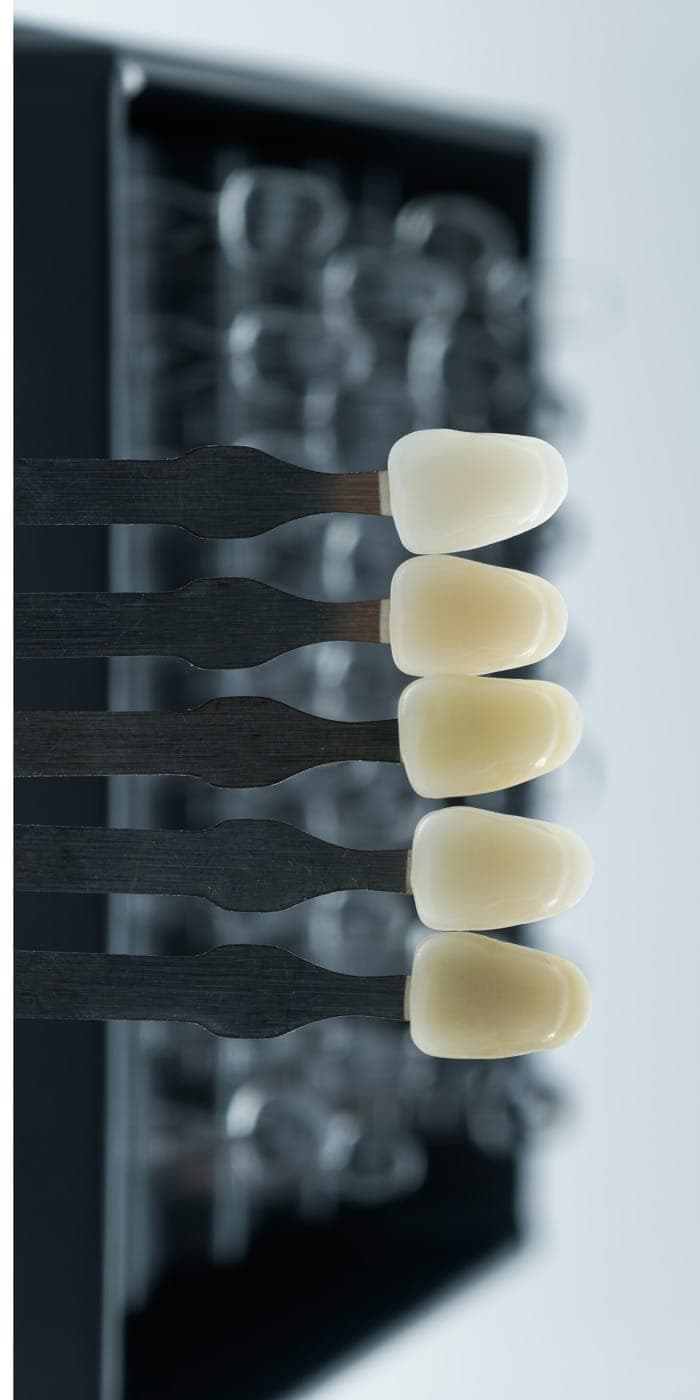
- Shade selection — agreed with the patient using a shade guide
- Treatment plan approval
Visit 2: Preparation and Impressions (1–2 hours)
- Minimal preparation — 0.3–0.5 mm of precise enamel reduction
- Digital or conventional impressions
- Temporary veneers — aesthetic protection while the lab works
- Laboratory fabrication: 5–10 working days
Visit 3: Bonding (1–2 hours)
- Try-in — checking colour, form and bite
- Bonding — cemented with a light-activated adhesive
- Final check — bite and polish
- Care instructions
Total time: 2–3 weeks (planning + laboratory + bonding)
Laminate Veneers vs Zirconium Crowns vs Bonding
| Feature | Laminate Veneer | Zirconium Crown | Bonding |
|---|---|---|---|
| Tooth reduction | Minimal (0.3–0.5 mm) | Moderate–high (1–2 mm) | None or minimal |
| Longevity | 10–20 years | 15–25 years | 3–5 years |
| Aesthetics | Most natural (translucent) | Very good | Moderate |
| Number of visits | 2–3 | 2–3 | 1 |
| Price (2026) | 8,500–18,000 TL | 5,500–12,000 TL | 1,500–3,500 TL |
| Who it suits | Mild–moderate aesthetic needs | Discolouration + fracture | Temporary/urgent |
| Stain resistance | Very high | Very high | Moderate |
| Fracture risk | Low–moderate | Very low | Moderate |
Who Are Laminate Veneers For?
Ideal candidates:
- Adults (18+)
- Healthy gums
- No decay, or minor decay already treated
- No bruxism
- Mild to moderate aesthetic concerns
- High aesthetic expectations
Not suitable for:
- Under 18 (tooth development not complete)
- Active periodontal disease
- Severe bruxism (night guard first)
- Advanced decay or fracture (restore first)
- Pregnancy (cosmetic treatment is postponed)
Laminate Veneer Prices (2026)
| Case | Per-tooth Price | 8 Teeth (Smile Design) |
|---|---|---|
| E-max premium (highest aesthetics) | 14,000–18,000 TL | 112,000–144,000 TL |
| Standard porcelain | 8,500–13,000 TL | 68,000–104,000 TL |
| Feldspathic (bespoke laboratory work) | 12,000–16,000 TL | 96,000–128,000 TL |
Factors that affect price:
- Porcelain brand (E-max, Cerinate, Empress)
- Laboratory quality
- Case complexity
- Additional treatment required (whitening, gum aesthetics, etc.)
Advantages and Disadvantages
Advantages
- Minimal tooth reduction — natural tooth structure is preserved
- Most natural aesthetics — translucency matches enamel
- Highly stain resistant — minimal effect from coffee, tea or smoking
- Long lasting — 10–20 years
- Single-visit fabrication possible (with CAD/CAM)
- Gum-friendly — no tissue reaction
Disadvantages
- Not reversible — once enamel is reduced it does not come back
- Fracture risk — can chip with hard biting
- Price — more expensive than bonding
- Laboratory dependency — 5–10 working days of fabrication
- Marginal fit matters — critical to gum health
Aftercare
First week:
- Avoid hard and sticky foods
- Avoid deeply staining drinks (coffee, red wine)
- Use a soft toothbrush
Long term:
- Brush twice a day
- Floss daily
- Dental check-up every 6 months
- If you grind your teeth, wear a night guard (essential)
- No chewing ice, nail-biting or biting hard objects
- Annual professional scaling
Do:
- Soft or medium-soft toothbrush
- Non-abrasive toothpaste
- Interdental brush or floss
- Night guard if bruxism is present
Don't:
- Bite hard-shell nuts (walnuts, pistachios)
- Chew sticky foods (caramel, chocolate bars)
- Smoke (staining and margin risk)
- Chew ice
- Sleep without your night guard if you have bruxism
References
- Strassler HE. Minimally invasive porcelain veneers: indications for a conservative esthetic dentistry treatment modality. Gen Dent. 2007;55(7):686–694. PubMed
- Peumans M, De Munck J, Mine A, Van Meerbeek B. Clinical effectiveness of contemporary adhesives for the restoration of non-carious cervical lesions. Dent Mater. 2014;30(10):1089–1103. PubMed
- Gresnigt MM, Kalk W, Ozcan M. Randomized clinical trial of indirect resin composite and ceramic veneers: up to 3-year follow-up. J Adhes Dent. 2013;15(2):181–190. PubMed
Thinking about laminate veneers? At Derya Dental Clinic in Maltepe, our dental team provides cosmetic dentistry. We use Digital Smile Design to show you the result before treatment begins, so your expectations are realistic.
📞 0216 572 05 20 💬 WhatsApp appointment
Related Guides
- Turkey Teeth Explained — what "Turkey teeth" really means: veneers vs crowns and costs
- Turkey Teeth Gone Wrong — why it happens and how to avoid it
- Cosmetic Dentistry — Full overview
- Types of Dental Fillings — Alternative for smaller problems
- Teeth Grinding (Bruxism) — Protect your veneers
Related Treatment Pages
This content is for informational purposes only and does not replace medical diagnosis or treatment. Please consult a specialist for decisions about your oral and dental health.