
What Are the Signs of a Failing Dental Implant?
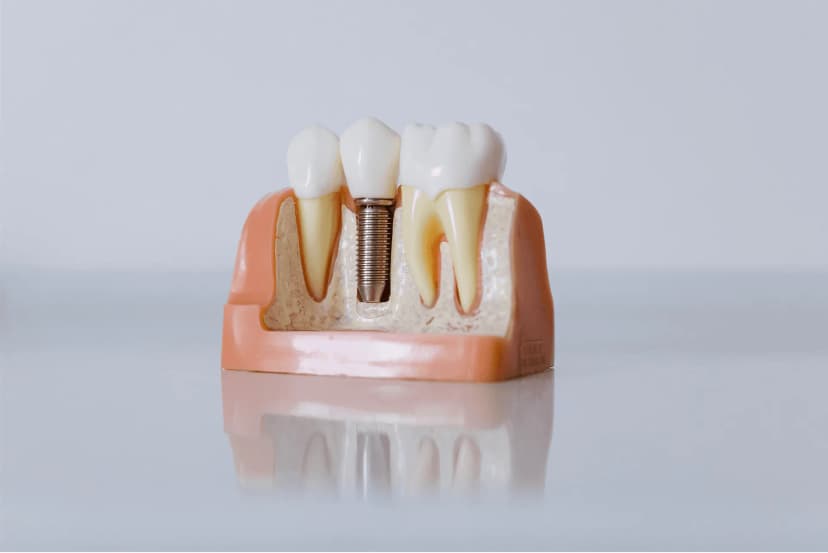
Dental implants are a reliable treatment with 95–99% success rates, but as with any surgery they carry a risk of complications. This guide explains the signs of a failing implant, the underlying causes, the cost of remedial treatment and how complications can be prevented — clearly and openly.
💡 Clinical note: Knowing the risks should not alarm you — it helps you make an informed decision. With an experienced team and proper planning, the great majority of complications can be prevented.
My Implant Is Loose or Has Fallen Out — What Should I Do?
Scenario 1: The Implant or Its Crown Is Loose
- Do not force or move the loose part
- Avoid chewing on that side — stick to soft food
- Rinse with warm salt water (one cup of water with half a teaspoon of salt)
- Arrange a dental review within 24 hours
- You may take an over-the-counter painkiller; do not start an antibiotic without your dentist's advice
Looseness can also be caused by a loose crown screw — that is repairable. Mobility of the implant body itself is more serious and needs prompt assessment.
Scenario 2: The Implant Has Come Out Completely
- Keep the lost part in a clean container (sterile gauze or clean water)
- Do not scrub the area with a brush; rinse only with salt water
- If there is bleeding, apply firm pressure with clean gauze for 15 minutes
- See a dentist within 24–72 hours
- Bring the lost part to your appointment — its make and condition guide the next treatment plan
Scenario 3: Swelling + Pain + Purulent Discharge
This combination of three signs points to peri-implantitis (inflammation).
- Call for a same-day appointment
- Over-the-counter analgesia (paracetamol or ibuprofen) is reasonable
- Do not start an antibiotic by yourself — your dentist will prescribe based on culture or imaging
- If there is pus, do not lie on that side at night (drainage control)
- Avoid hot compresses on the area (they spread the inflammation)
⚠️ Same-day emergency signs: Difficulty swallowing or breathing, swelling spreading under the jaw, fever above 38.5°C. These can indicate facial cellulitis or Ludwig's angina.
Why Do Dental Implants Fail? Six Main Causes
1. Insufficient Bone Quality or Volume
In patients with bone loss in the jaws, the implant may not find adequate bony support. This is one of the most common causes of implant failure.
Solution: Bone grafting or a zygomatic implant to establish bony support.
2. Peri-Implantitis (Inflammation Around the Implant)
Poor maintenance allows bacteria to accumulate around the implant and cause inflammation. Untreated, this results in loss of the supporting bone.
Solution: Regular implant maintenance, professional cleaning and early intervention.
3. Smoking
Smoking reduces blood flow by around 70%, delays healing and increases the risk of infection threefold.
Solution: Stop smoking for at least two weeks before surgery and eight weeks afterwards.
4. Systemic Conditions
Uncontrolled diabetes, osteoporosis, autoimmune disease and certain medications (including bisphosphonates used for bone resorption) can all compromise implant success.
Solution: Bring the underlying condition under control and coordinate with the patient's medical team.
5. Surgical Factors
The wrong angulation, inadequate primary stability (torque), breaches in sterility or the wrong choice of implant can all lead to failure.
Solution: An experienced surgeon, digital planning and the use of a surgical guide.
6. Overloading
Excessive early loading of the implant (chewing hard food, bruxism) can disrupt osseointegration.
Solution: A soft diet during healing, plus a night guard if the patient has bruxism.
Timeline of Failing Implant Signs
The signs of implant failure differ according to when they appear. The timeline below helps you tell normal healing apart from abnormal warning signs.
First 24–72 Hours — Normal vs Abnormal
| Sign | Normal | Abnormal (See Your Dentist) |
|---|---|---|
| Pain | Decreasing, controllable with painkillers | Increasing, unresponsive to medication |
| Swelling | Mild and localised | Spreading, one-sided facial swelling |
| Bleeding | Slight tinge in saliva | Active, persistent bleeding |
| Fever | None | Above 38°C |
| Taste/Smell | Metallic taste of blood (1–2 days) | Persistent foul taste or odour of pus |
1–2 Weeks — Expected Healing Window
By this point swelling should have settled, suture sites should have closed and pain should be gone. Warning signs include:
- Persistent swelling beyond day 14
- Wound dehiscence (sutures opening, exposing implant body)
- Tenderness on touch at the implant site
- Halitosis (bloody or inflamed odour)
3 Weeks – 6 Months — Early Failure Window
This is when failure of osseointegration (bone-to-implant integration) typically becomes apparent. The most critical window.
- Mobility of the implant — a definitive sign that integration has not occurred
- Persistent pain on chewing
- Purulent discharge from the gum (chronic infection)
- Persistent metallic taste or foul odour
- Radiolucent (dark) area around the implant on radiographs
📊 Data: Around 75% of early failures are detected in this window. Mobility tends to appear after the soft tissue has finished healing.
6 Months and Beyond — Late Failure (Peri-Implantitis Phase)
Late failure is most often caused by peri-implantitis (inflammation around the implant). It occurs in 5–10% of patients on five- to ten-year follow-up.
- Gum recession — the metal of the implant body becomes visible
- Bone loss — radial bone resorption visible around the implant on radiographs
- Bleeding — when flossing or brushing
- Crown loosening or fracture
- Pain on chewing (if newly arising in the late phase)
- Redness and swelling around the implant
⚠️ Warning: If you notice any of these signs, see your dentist within 24–72 hours. Early intervention saves the implant in the great majority of cases; late presentations may require removal.
Healthy Implant vs Failing Implant — How Can I Tell?
These observations can be made by patients themselves:
| Criterion | Healthy Implant | Failing Implant |
|---|---|---|
| Movement | Fixed like a tooth, no movement | Slight wobble, moves with pressure |
| Gum colour | Pinkish, natural | Red, purple or bright red |
| Gum line | Even with neighbouring teeth | Receded, screw threads visible |
| Chewing sensation | Like a natural tooth | Pain, pressure or reaction |
| Odour | None | Persistent foul odour, metallic taste |
| Floss | Glides smoothly | Bleeds or catches |
| Annual radiograph | Stable surrounding bone | Dark area around screw, bone loss |
| Probing (clinical check) | Pocket depth under 3 mm | Pocket of 5+ mm with bleeding |
💡 A practical home test: Pass dental floss around the crown of the implant. No bleeding and no catching is a good sign. Bleeding or a foul odour can be the start of peri-implantitis and warrants a check.
Are Dental Implants Harmful?
Dental implants are a safe, well-established treatment. Like any surgery, however, they carry some risks.
Possible Risks and Their Frequency
| Risk | Frequency | Comments |
|---|---|---|
| Temporary numbness | 2–3% | Where the implant is close to the inferior alveolar nerve; usually transient |
| Infection | 1–2% | Controlled with antibiotics and good hygiene |
| Implant loss | 1–5% | 1–2% in experienced hands |
| Peri-implantitis | 5–10% (long-term) | Preventable with regular maintenance |
| Sinus perforation | 1–3% (upper jaw) | Minimised by surgical experience |
| Screw fracture | Less than 1% | Very rare with quality components |
Are Dental Implants Safe?
Yes. Dental implants have a track record of more than 50 years in clinical use and are approved by the FDA and under CE marking. Success rates are 95–99%, and the majority of risks are preventable or treatable.
How to Prevent Complications
Before Treatment
- Detailed bone analysis with 3D CBCT
- Digital implant planning for accurate positioning
- Guided surgery to minimise human error
- Control of any systemic conditions
- Smoking cessation (at least 2 weeks before surgery)
After Treatment
- Take prescribed medication in full
- A soft diet during healing
- Regular implant maintenance
- A professional cleaning and review every 6 months
- A night guard if you have bruxism
Treatment of a Failed Implant: Step-by-Step Process
If an implant fails, there are clear options. The path depends on the cause of failure and the state of the bone.
Five-Stage Treatment Roadmap
- Removal of the implant — a straightforward surgical procedure under local anaesthesia (15–30 minutes)
- Debridement and disinfection of the site — inflamed tissue is cleared and antibiotics are started
- Healing period — 3–6 months, depending on the extent of bone loss and infection
- Bone grafting if required — when bone is inadequate, a graft is placed (a further 4–6 months of healing)
- Placement of the new implant — the cause of the original failure is reviewed and the brand, diameter and surgical technique are adjusted accordingly
Cost of Treating a Failed Implant (2026)
| Procedure | Price Range (TRY) | Approx. EUR / GBP | Duration | Includes |
|---|---|---|---|---|
| Implant removal (simple) | 1,500 – 3,500 ₺ | 45–105 € / 40–90 £ | 15–30 min | Local anaesthesia, sutures, follow-up |
| Implant removal (complex) | 3,500 – 6,500 ₺ | 105–195 € / 90–165 £ | 30–60 min | Ankylosed or deeply submerged cases |
| Surgical treatment of peri-implantitis | 4,000 – 8,000 ₺ | 120–240 € / 100–205 £ | 45–90 min | Flap surgery, decontamination, regenerative graft |
| Bone graft (small) | 4,000 – 8,000 ₺ | 120–240 € / 100–205 £ | — | Single site, synthetic or allograft |
| Bone graft (large) + sinus lift | 8,000 – 18,000 ₺ | 240–540 € / 205–460 £ | — | Advanced bone loss |
| New implant placement (single) | 8,000 – 20,000 ₺ | 240–600 € / 205–510 £ | — | Depending on brand segment — see implant prices |
| Temporary prosthesis (bridge or partial) | 2,500 – 6,000 ₺ | 75–180 € / 65–155 £ | — | Aesthetic and functional cover during healing |
Estimated total cost (removal + healing + graft + new implant): 15,000 – 40,000 ₺ (450–1,200 € / 385–1,025 £) depending on the case.
💡 Note: If the original failure stems from a surgical error during the first procedure, some clinics will redo the treatment free of charge or at a discount under their clinical guarantee. Speak with your original dentist about this.
🌍 For international patients: EUR/GBP equivalents are based on the May 2026 exchange rate. The clinic provides a written cost estimate in your preferred currency before treatment.
Success Rate of a Second Implant
After a failed implant, the success rate of the second attempt is 90–95% in systematic reviews (Chrcanovic et al. 2014). Identifying the cause of the original failure and addressing it minimises the risk second time round. Smoking cessation, control of any systemic disease, and a different brand or surgical technique are all factors that improve success.
Alternative Solutions
If a second implant is not pursued:
- Dental implant or bridge — a fixed prosthesis supported by neighbouring teeth
- A removable partial denture — lower-cost alternative
- All-on-4 / All-on-6 — a fixed prosthesis on 4 or 6 implants for the whole arch (where bone is sufficient)
- Zygomatic implants — a solution for cases of advanced bone loss
References
- Pjetursson BE, Thoma D, Jung R, Zwahlen M, Zembic A. A systematic review of the survival and complication rates of implant-supported fixed dental prostheses after a mean observation period of at least 5 years. Clin Oral Implants Res. 2012;23 Suppl 6:22–38. PubMed
- Derks J, Tomasi C. Peri-implant health and disease. A systematic review of current epidemiology. J Clin Periodontol. 2015;42 Suppl 16:S158–S171. PubMed
- Jung RE, Pjetursson BE, Glauser R, Zembic A, Zwahlen M, Lang NP. A systematic review of the 5-year survival and complication rates of implant-supported single crowns. Clin Oral Implants Res. 2008;19(2):119–130. PubMed
- Chrcanovic BR, Albrektsson T, Wennerberg A. Reasons for failures of oral implants. J Oral Rehabil. 2014;41(6):443–476. PubMed
- Heitz-Mayfield LJA, Salvi GE. Peri-implant mucositis. J Periodontol. 2018;89 Suppl 1:S257–S266. PubMed
- Schwarz F, Derks J, Monje A, Wang HL. Peri-implantitis. J Periodontol. 2018;89 Suppl 1:S267–S290. PubMed
Concerned about your implant treatment? At Maltepe Derya Dental Clinic we can carry out a detailed examination with 3D CBCT and produce a personal risk assessment for you. International patients welcome — written estimates in EUR or GBP available. Please get in touch.
Related Treatment Pages
This content is for informational purposes only and does not replace medical diagnosis or treatment. Please consult a specialist for decisions about your oral and dental health.