
Missing Teeth: Implant or Bridge? The Right Choice Guide
Let us compare these two treatment options in detail and find the most suitable solution for you.
Implant Treatment: The Gold Standard of Modern Dentistry
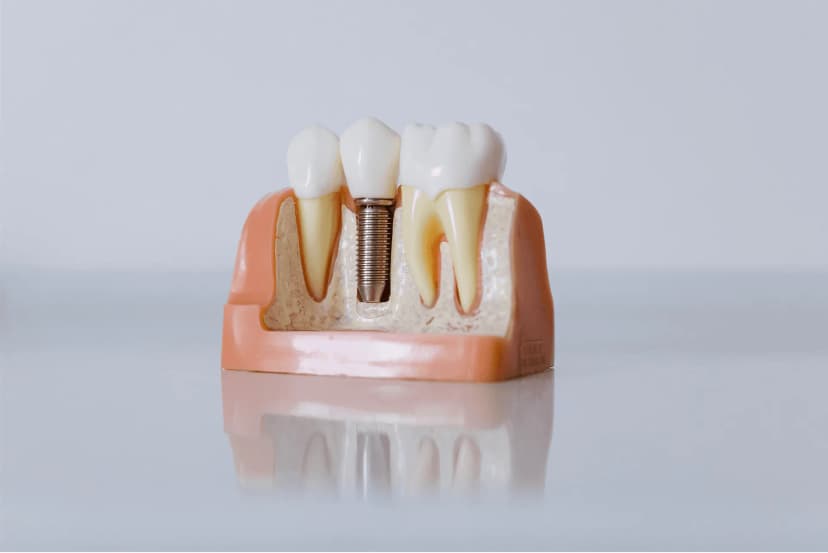
A dental implant is a treatment method that begins with a titanium screw placed into your jawbone and mimics the natural tooth root. This treatment replaces your missing tooth without damaging any adjacent teeth.
How Is Implant Treatment Performed?
- Detailed Examination and Planning: Jawbone is analyzed with 3D tomography
- Surgical Phase: The implant screw is placed into the jawbone
- Healing Period: The implant integrates with the bone over 2-4 months (osseointegration)
- Prosthesis Placement: The permanent tooth prosthesis is placed on the implant
Note: Rushing implant treatment can lead to failure. The bone integration process requires patience, but the result lasts a lifetime.
Fundamental Advantages of Implants
- Bone preservation: Jawbone resorption stops
- Adjacent teeth are protected: No healthy teeth are touched
- Long lifespan: Lasts a lifetime with proper care
- Natural feel: Provides chewing force like a real tooth
Dental Bridge: For Those Seeking a Quick Solution
A dental bridge is a traditional method in which the healthy teeth adjacent to the missing tooth are reduced in size for support. A three-unit structure is created to fill the gap in the middle.
Bridge Treatment Process
- Preparation of Support Teeth: Adjacent teeth are reduced (irreversible procedure)
- Impression and Temporary Bridge: Temporary solution applied during the laboratory phase
- Permanent Bridge Cementation: Treatment completed within 1-2 weeks
Limited Advantages of Bridges
- Quick results: Completed within 2 weeks
- No surgery: Does not require an operation
- Cost: Appears more economical initially
Comparison Table: Which Option Is Right for You?
| Criterion | Implant | Bridge |
|---|---|---|
| Intervention on Healthy Teeth | None required | 2 healthy teeth are reduced |
| Jawbone Health | Preserves and strengthens | Bone resorption continues |
| Treatment Duration | 2-4 months | 1-2 weeks |
| Lifespan | Lifetime | 7-15 years |
| Daily Cleaning | Like a natural tooth | Special tools required |
| Need for Replacement | None | Every 10-15 years |
| Aesthetic Longevity | Unchanged | Gum recession occurs over time |
Cost Analysis: Which Is More Economical in the Long Run?
Most patients focus on the initial cost, but the real calculation should be made over a 20-year period:
Implant Cost (20-Year)
- Initial cost: X TL
- Maintenance: Minimal
- Total: X TL
Bridge Cost (20-Year)
- Initial cost: 0.7X TL
- 2nd renewal (year 10): 0.7X TL
- Possible complications: 0.3X TL
- Total: 1.7X TL
Conclusion: An implant is a 40% more economical option in the long term.
In Which Cases Is a Bridge Preferred?
Situations where bridge treatment makes sense:
- Adjacent teeth are already filled or broken
- Health conditions that prevent surgical procedures
- Very advanced age and short life expectancy
- Bone insufficiency where grafting is not possible
Cases Where Implants Cannot Be Placed
In certain situations, an implant may not be possible:
- Uncontrolled diabetes
- Severe bone loss (can be resolved with grafting)
- Active cancer treatment
- Heavy smoking (20+ cigarettes per day)
Having trouble making your decision? Let us determine the most suitable treatment for you with an examination at our Maltepe clinic. Book Your Examination Appointment Now
Related Treatment Pages
This content is for informational purposes only and does not replace medical diagnosis or treatment. Please consult a specialist for decisions about your oral and dental health.