Dental Implant Treatment: Detailed Surgery and Recovery Process Guide

Ağız, Diş ve Çene Cerrahisi Uzmanı
Çene cerrahisi uzmanı Aykut Gürel, İstanbul Üniversitesi mezunu olup uzmanlık eğitimini Marmara Üniversitesi Ağız, Diş ve Çene Cerrahisi Anabilim Dalı'nda tamamlamıştır. Dental implantoloji, zigomatik implant cerrahisi ve dijital cerrahi planlama alanlarında çalışmaktadır.
Bu içerik Uzm. Dt. Aykut Gürel tarafından hazırlanmıştır. Yalnızca bilgilendirme amaçlıdır; klinik muayene yerine geçmez.
Son güncelleme: March 18, 2026
Dental implants are one of the most successful treatment methods in modern dentistry, used to provide natural-looking and functional teeth to replace missing ones. At our clinic in Maltepe, thanks to the digital planning techniques we have been applying for years, each patient's treatment process is calculated in advance and shared transparently. You can explore what a dental implant is in more detail.
How Is a Dental Implant Placed? Detailed Surgery and Recovery Process Guide
Why Is Implant Treatment So Popular?
In modern dentistry, implant treatment offers a superior alternative to traditional prostheses and bridge treatments:
- Does not damage adjacent teeth - Unlike bridge treatment, healthy teeth are not cut
- Prevents bone loss - Transmits chewing forces directly to the bone
- Provides a natural feel - You experience the same comfort and confidence as your real teeth
- Long-lasting solution - Can be used for 20-25 years with proper care
My Clinical Experience: In my practice spanning over 10 years, I observe that 98% of properly planned implants successfully achieve osseointegration.
How Is a Dental Implant Placed? 4 Fundamental Stages
1. Detailed Examination and 3D Digital Planning
The secret to a successful implant lies in proper planning. During this stage:
- A detailed intraoral examination is performed
- 3D jaw tomography (CBCT) is taken to measure bone structure with millimetric precision
- Nerve and vascular structures are mapped
- Implant position is determined through digital simulation
- A surgical guide is designed if necessary
Thanks to this meticulous planning, surgery time is shortened and the success rate is maximized.
2. Implant Surgery (15-30 Minutes)
Implant placement surgery is performed under local anesthesia:
- Anesthesia application - The area is completely numbed
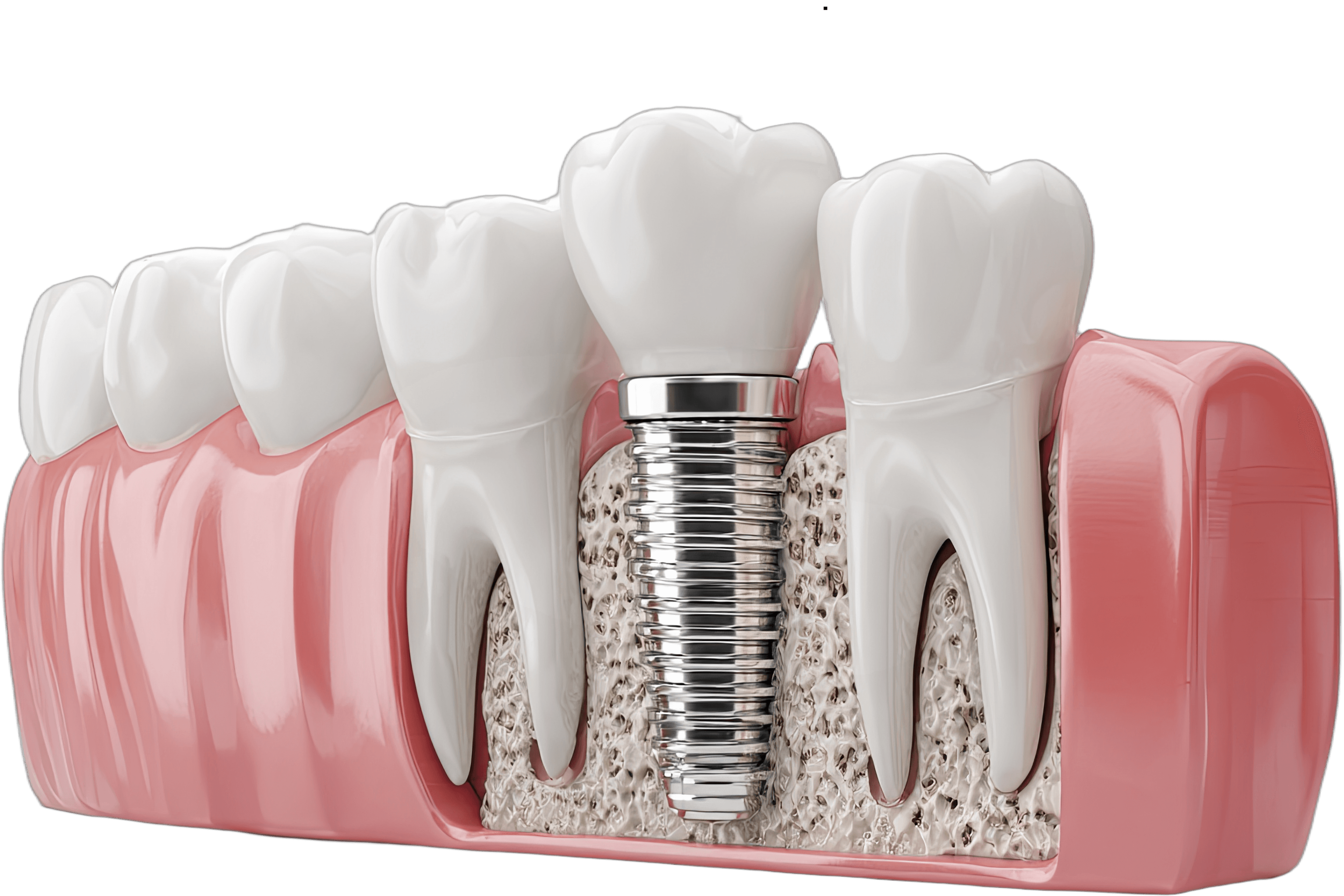
- Bone bed preparation - Space is created for the titanium screw using specialized drills
- Implant placement - The biocompatible titanium screw is placed into the bone
- Closure - Closed with sutures if necessary
Patient Comfort: At our clinic, with the sutureless implant method, we perform suture-free procedures in 80% of our patients.
3. Healing and Osseointegration Process
During this critical period, implant-to-bone fusion occurs:
| Area | Healing Time | Characteristics |
|---|---|---|
| Lower jaw | 2-2.5 months | Harder bone structure |
| Upper jaw | 3-4 months | Softer bone, longer duration |
| Anterior area | 2-3 months | Aesthetic zone, faster healing |
You can access detailed information about what to watch for during the post-implant healing process.
4. Fabrication and Placement of the Permanent Tooth
Once healing is complete, the final stage begins:
- A digital impression is taken (no traditional impression material needed)
- A customized tooth is designed in the laboratory
- Color and form harmony is matched with natural teeth
- The permanent tooth is screwed or cemented onto the implant
Advantages of Sutureless Implants with Surgical Guides
The surgical guide method we have developed through digital technology offers significant advantages over conventional implant surgery:
Surgical Guide Advantages:
- 90% less pain - Minimal trauma as the gum is not incised
- Faster healing - Closed surgery requiring no sutures
- High precision - Implant placement with 0.1 mm accuracy
- Short surgery time - Average 10-15 minutes
Technology Advantage: In cases where we apply guided implant surgery with digital planning, the complication rate stays below 2%.
Implant vs Bridge: Which Treatment Is More Advantageous?
| Criterion | Dental Implant | Dental Bridge |
|---|---|---|
| Damage to adjacent teeth | Does not cause damage | Healthy teeth are cut |
| Durability | 20-25 years | 8-12 years |
| Bone preservation | Prevents bone loss | Bone resorption continues |
| Cleaning | Like a natural tooth | Special floss required |
| Aesthetics | Excellent | Good |
| Cost | High (economical long-term) | Medium |
For a detailed comparison, review our article on implant vs bridge.
Who Can Get a Dental Implant?
Implant Can Be Placed:
- Individuals over 18 (jaw development completed)
- Patients in good general health
- People with adequate bone volume
- Individuals who prioritize oral hygiene
Conditions Requiring Careful Evaluation:
- Controlled diabetes - HbA1c should be below 7
- Osteoporosis - Medication use is evaluated
- Heart diseases - Cardiologist approval is obtained
- Bone insufficiency - Can be resolved with bone grafting
Conditions Where Implants Cannot Be Placed:
- Uncontrolled diabetes (HbA1c >8)
- Active cancer treatment
- History of intensive radiotherapy
- Serious blood clotting disorders
You can get more detailed information on who cannot get implants.
Post-Implant Recovery Process and Care
First 24 Hours:
- Cold compress application (20 min on, 20 min off)
- Soft diet - Soup, yogurt, puree
- Smoking and alcohol strictly prohibited
- Regular use of prescribed antibiotics and pain medication
First Week:
- Daily saltwater gargle (1 teaspoon salt + 1 glass warm water)
- Avoid hard brushing
- Do not consume hot beverages
- Do not touch the surgical area with your tongue or fingers
Long-Term Care:
- Brush twice daily - with a soft-bristled brush
- Interdental brush usage
- Check-up every 6 months
- Not smoking - extends implant life by 10 years
You can review our detailed guide on implant care and cleaning.
Ways to Prevent Implant Failure
Patient Responsibility:
- Pay meticulous attention to oral hygiene
- Do not miss regular check-ups
- Quit smoking - increases the success rate by 15%
- Avoid hard foods
Clinician Responsibility:
- Correct diagnosis and planning
- Sterile surgical conditions
- Quality implant materials - implant brands
- Implementing follow-up and care protocols
Clinical Success: 97.8% of the 2000+ implants we have placed in the last 5 years at our clinic successfully achieved osseointegration.
Special Situations and Alternative Methods
Same-Day Implant (Immediate Implant)
Implant placement in the same session as tooth extraction. The immediate implant procedure is preferred in suitable cases.
Full Edentulism Solutions
- All-on-4 Technique - Fixed prosthesis on 4 implants
- All-on-6 Technique - Stronger support with 6 implants Get detailed information about All-on-4 and All-on-6.
Solutions for Bone Insufficiency
- Sinus lifting surgery
- Bone graft application
- Zygomatic implant - placement into the cheekbone
This content is for informational purposes only and does not replace medical diagnosis or treatment. Please consult a qualified healthcare professional for decisions regarding your oral and dental health.
Frequently Asked Questions
Answered by our specialist
Does implant surgery hurt?
How long does an implant take to heal?
Can an implant be placed on the same day as tooth extraction?
Up to what age can implant treatment be performed?
Can smokers get implants?
How long does an implant last?
Have questions about your treatment?
Consult our specialist doctors. Book an appointment and get a personalized treatment plan.
Related Articles

March 23, 2026
Oral and Maxillofacial Surgery in Maltepe: Safe Treatment with a Specialist
Looking for an oral surgeon in Maltepe? At Derya Dental Clinic, get impacted tooth extraction, implant surgery, jaw cyst removal, and bone grafting performed safely by Specialist Dt. Aykut Gurel.
March 23, 2026
Dental Fillings in Maltepe: Treatment Process, Types, and Prices
Looking to get a dental filling in Maltepe? Aesthetic composite fillings, porcelain inlays and onlays at Derya Dental Clinic. Filling types, prices, and care guide.
March 23, 2026
Dentist in Maltepe: Comprehensive Treatment with a Specialist Team
Looking for a dentist in Maltepe? At Derya Dental Clinic, get all your dental treatments done safely with a team of 5 dentists including an oral surgery specialist. Easy access in Findikli.